A software requirements specification (SRS) states what a system must do and the qualities it must have, precisely enough to design, build and verify it. Following the structure of ISO/IEC/IEEE 29148, it covers an introduction, an overall description, functional requirements, external interfaces, non-functional requirements, data requirements and how each requirement will be verified. Give each requirement an identifier, make it measurable and trace it to a goal and a test.
When you need an SRS
A software requirements specification (SRS) sets out what a system must do and the qualities it must have, precisely enough to design, build and verify it. It earns its effort for regulated systems, fixed-price contracts, integration-heavy projects and work split between several suppliers. For an exploratory product, a PRD and a maintained backlog are often enough; write the SRS for the parts where ambiguity would be expensive.
Where the SRS fits
The SRS refines the PRD where ambiguity would be expensive. It gives the RFP and the SOW requirements that can be priced, tested and accepted.
Each document answers one question, then hands its answer to the next.
Define what you need
- PRDProduct requirements document
What must the product do, and how will we know it works?
Hands onGoals, user stories and acceptance criteria
- SRSYou are hereSoftware requirements specification
Exactly how must the system behave?
Hands onTestable, traceable requirements
Choose and agree
- CompareProposal comparison
Which offer is sound, not just cheapest?
Hands onA chosen partner and open risks
- SOWStatement of work
What exactly have we agreed to deliver?
Hands onDeliverables, acceptance and change control
The standard behind most SRS templates
ISO/IEC/IEEE 29148:2018 is the international standard for requirements engineering. It specifies the information items that requirements processes produce, including a software requirements specification, and the content each should contain. Older templates often follow IEEE 830-1998, which the standard's first edition replaced in 2011. The template on this page follows that structure in simplified form; if a contract or regulator requires conformance, work from the standard itself.
What a software requirements specification contains
A practical SRS has these parts:
- Introduction: purpose, scope, definitions and referenced documents.
- Overall description: how the system fits with others, its users, operating environment, constraints, assumptions and dependencies.
- Functional requirements, grouped by feature or user goal.
- External interfaces: user interface, other software, hardware and communications.
- Non-functional requirements: performance, security, reliability and availability, usability and accessibility, maintainability.
- Data requirements: the main records, their sources, retention and migration.
- Verification: how each requirement will be shown to be met.
- Traceability from business goals to requirements to tests.
Copy the SRS template
Number every requirement so it can be referenced in designs, tests, change requests and contracts. Keep requirements that are not yet agreed in a separate, clearly marked section.
Write each requirement so it can be tested
Give every requirement a unique identifier, state one requirement per statement and make it measurable. “The system shall be fast” cannot be verified; “search results shall appear within two seconds for 95% of queries under the expected peak load” can. If no one can describe the test, the requirement is not finished. Borrow from published standards where they exist: WCAG 2.2, the W3C accessibility standard, writes its success criteria as “testable statements”, so “meets WCAG 2.2 level AA” is a requirement a tester can check.
Turn vague requirements into testable ones
Rewrite any requirement that nobody could test. These examples show the pattern; set the actual numbers from your own users, load and obligations.
| Vague | Testable | Verified by |
|---|---|---|
| The system shall be fast | Search results appear within 2 seconds for 95% of queries at the expected peak load | Load test |
| The system shall be secure | Only users with the Manager role can export customer records; each export is logged | Test and log inspection |
| The system shall be easy to use | The booking journey meets WCAG 2.2 level AA | Accessibility audit |
| The system shall always be available | Monthly availability of at least 99.5%, excluding announced maintenance | Monitoring report |
Non-functional requirements shape the architecture
Availability targets, data residency, response times, accessibility standards and audit needs often decide the technical design more than the features do. Write them early, agree how each will be measured and ask any development partner to explain how their proposal meets them.
Trace requirements to goals and tests
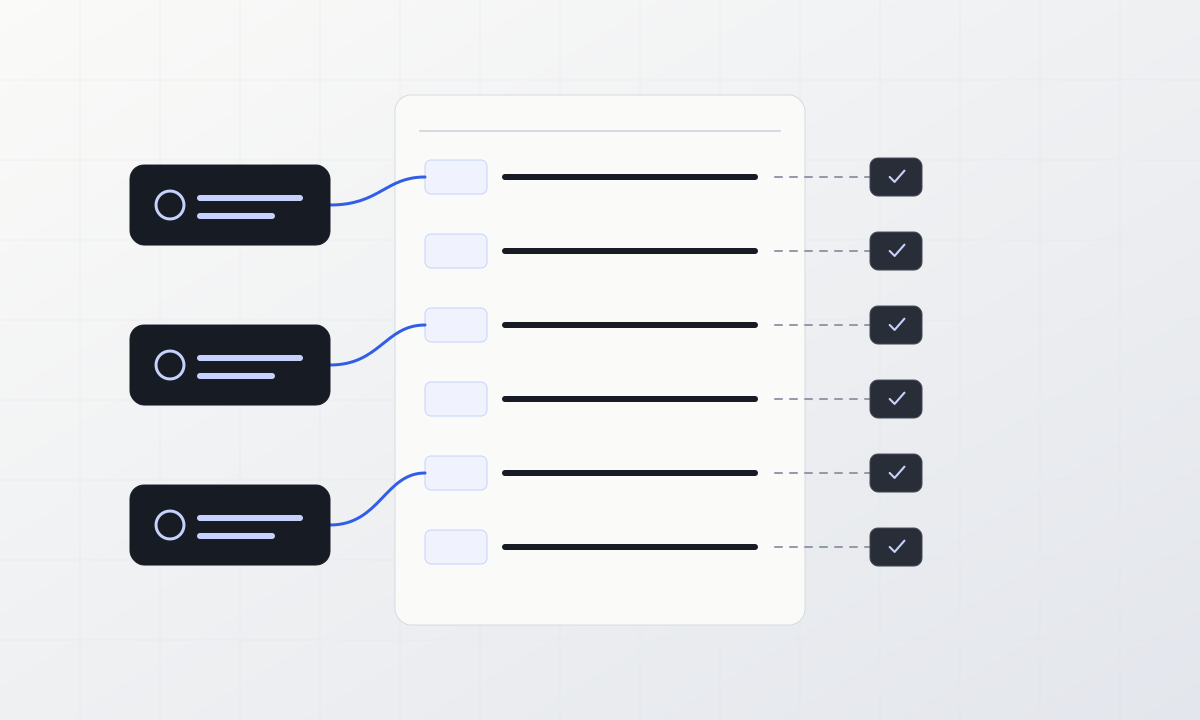
A traceability matrix links each requirement to the business goal it serves and to the test that verifies it. It shows requirements that serve no goal, goals with no requirements and requirements with no test. The Systems Engineering Body of Knowledge (SEBoK) puts it plainly: “Traceability helps ensure the requirements trace to their needs, and that they are correct and complete.” It also makes the impact of a change visible before the change is approved.
A minimal traceability matrix
Start with a simple table and keep it current; a spreadsheet is enough for most projects. Any empty cell is a question to answer before release.
| Business goal | Requirement | Test |
|---|---|---|
| Reduce phone bookings | FR-004 Patients can book an available slot online | TC-012 Booking a free slot; TC-013 Slot no longer offered |
| Protect patient data | NFR-002 Records are only visible to permitted roles | TC-031 Access denied for other patients' records |
| Keep the service available | NFR-005 Monthly availability of at least 99.5% | Monthly monitoring report |
Keep the SRS under change control
An SRS is a baseline, not a frozen document. Version it, record who approved each change and keep the traceability matrix current. When the SRS forms part of a contract, route changes through the agreed statement of work change process.
Questions buyers ask
What is an SRS document?
A software requirements specification states what a system must do and the qualities it must have, precisely enough to design, build and verify it. It usually covers an overall description, functional and non-functional requirements, interfaces, data and how each requirement will be verified.
Is IEEE 830 still the standard for SRS documents?
IEEE 830-1998 was replaced by ISO/IEC/IEEE 29148, first published in 2011; the current edition is from 2018. Many templates still follow the older IEEE 830 layout, which remains a reasonable structure, but cite 29148 when a contract or regulator expects the current standard.
What is the difference between functional and non-functional requirements?
Functional requirements describe what the system does, for example that a patient can book an available appointment. Non-functional requirements describe how well it must do it: response times, availability, security, accessibility and maintainability. Non-functional requirements often shape the architecture most.
What is a requirements traceability matrix?
A table linking each business goal to the requirements that serve it and the tests that verify them. It reveals requirements with no purpose, goals with no requirements and requirements with no test, and shows what a proposed change will affect before it is approved.
Sources and editorial approach
Scopeivo publishes practical planning guidance. Examples and suggested rubrics are decision aids, not evidence of delivered projects or guaranteed outcomes. Adapt them to your context and verify material assumptions with the people responsible.
- Related delivery guidance
- SEBoK — System Requirements Definition
- W3C — Web Content Accessibility Guidelines (WCAG) 2.2
Read our research and publication approach. Original publication dates are retained; the update date reflects substantive changes to this guide.